
Foreign ESOPs and Schedule FA Disclosure: A Guide for Indian Employees
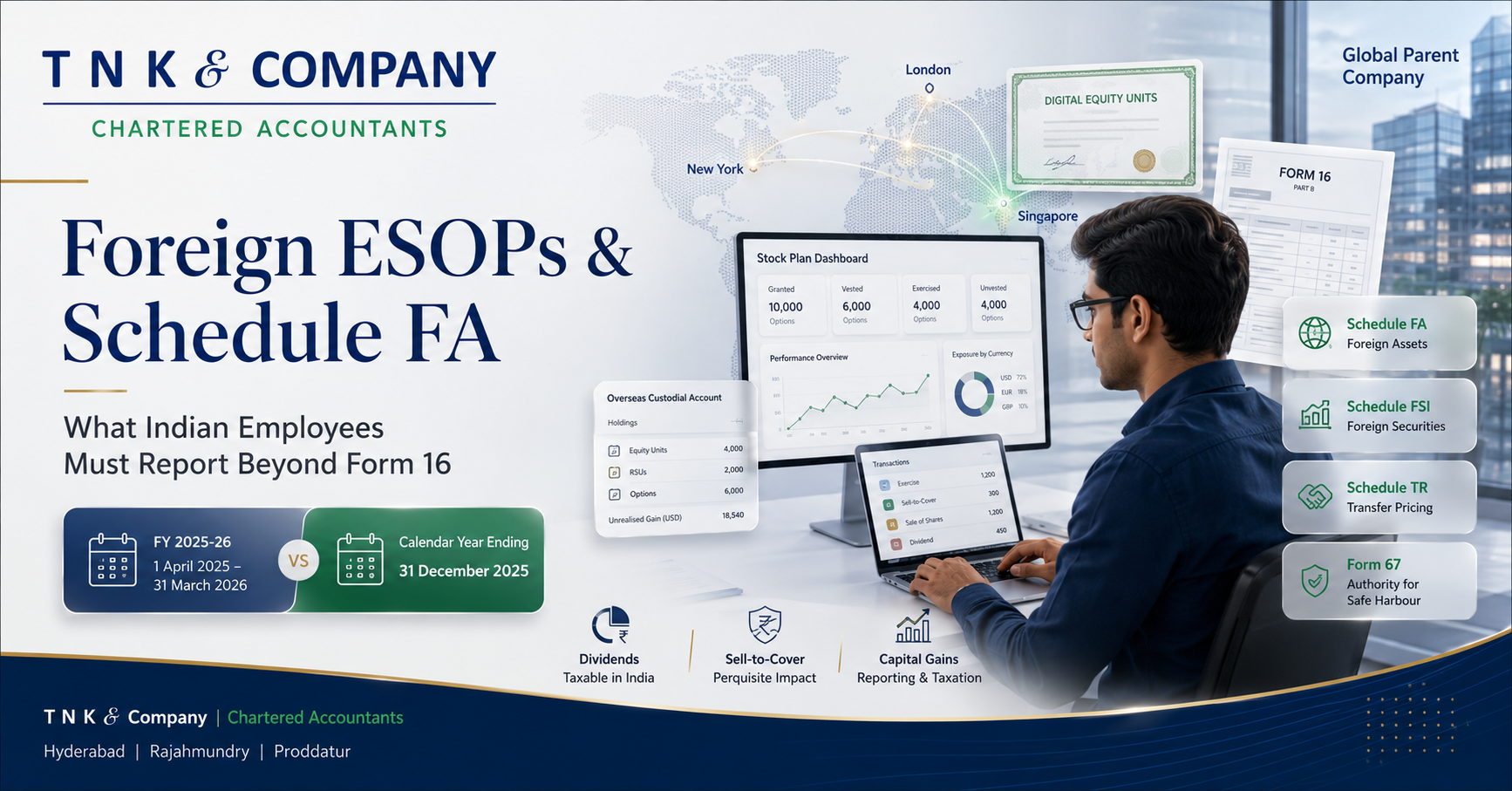
Although the Income-tax Act, 2025 and Income-tax Rules, 2026 came into force from 1 April 2026, income of FY 2025-26 and the related AY 2026-27 return continue to be governed by the Income-tax Act, 1961, Income-tax Rules, 1962 and the ITR forms notified for AY 2026-27 under that framework. The new Act applies to tax years beginning on or after 1 April 2026.
Two different reporting periods must be kept in mind:
- Salary, dividends and capital gains are generally reported for 1 April 2025 to 31 March 2026.
- Schedule FA for AY 2026-27 examines applicable foreign assets and accounts held at any time during the calendar year ending 31 December 2025.
This financial-year versus calendar-year difference is one of the most important practical issues in foreign ESOP reporting. The dates, forms and provisions must be reverified before adapting this article for a later assessment year.
Introduction
Consider a common arrangement in the technology and multinational-company sectors.
An employee works for the Indian subsidiary or Indian group company of a US, UK, European or other overseas organisation. As part of the employee’s compensation package, the foreign parent company grants RSUs, ESOPs or employee shares. When the award is settled, shares are credited to an overseas stock-plan account maintained with E*TRADE, Morgan Stanley, Fidelity, Charles Schwab or another global broker or custodian.
The Indian employer includes an ESOP or RSU perquisite in payroll and Form 16. The employee therefore assumes that all Indian tax compliance has been completed.
That assumption may be incorrect.
Form 16 may address salary taxation, but it may not independently complete the employee’s obligations relating to:
- Foreign-asset disclosure;
- Overseas brokerage or custodial-account disclosure;
- Foreign dividend income;
- Capital gains or losses;
- Schedule FSI;
- Schedule TR;
- Form 67;
- Foreign tax credit; and
- Schedule FA.
Reporting the ESOP perquisite in Form 16 and disclosing the foreign shares in Schedule FA are separate compliance requirements. Completion of one does not automatically complete the other.
Executive Summary
For a Resident and Ordinarily Resident employee, a foreign stock award may create three distinct layers of compliance:
- Salary taxation when the specified securities are allotted or transferred under the applicable stock-plan structure;
- Capital-gains taxation when shares are subsequently sold, including an actual sell-to-cover sale; and
- Foreign-asset, foreign-income and foreign-tax reporting through Schedule FA, Schedule FSI, Schedule TR and Form 67, wherever applicable.
The correct treatment depends on the legal nature of the award, exercise or settlement mechanics, allotment or transfer date, residential status, country of the foreign entity, brokerage structure and relevant assessment year.
Table of Contents
- Why Schedule FA disclosure should not be ignored
- Types of employee stock awards
- Typical foreign ESOP structure
- Stage one: taxation as salary perquisite
- Cost of acquisition
- Stage two: capital gains on sale
- Numerical illustration
- Foreign dividends and foreign tax credit
- Residential status
- Schedule FA reporting period
- Relevant Schedule FA tables
- Currency conversion
- Correct ITR form
- Documents and reconciliation
- Common mistakes
- Consequences and corrective action
- Case studies
- Final checklist
Why Schedule FA Disclosure Should Not Be Ignored
Foreign stock awards are now a routine component of compensation in Indian IT companies, consulting firms, pharmaceutical businesses, global capability centres and multinational groups.
A foreign share or overseas stock-plan account may require examination even when:
- No funds were remitted to India;
- The employee did not voluntarily open the account;
- The current account balance is nil;
- All shares were sold before 31 December;
- Only a small dividend was received;
- Sale proceeds were retained overseas; or
- The salary perquisite already appears in Form 16.
The AY 2026-27 ITR-2 form asks for foreign accounts and investments held at any time during the calendar year ending 31 December 2025. Table A2 separately deals with foreign custodial accounts, while Table A3 deals with foreign equity and debt interests.
Information relating to foreign financial accounts may also be available to the Indian tax authorities under international information-exchange frameworks such as CRS and FATCA. Official guidance states that such information may include the account holder’s identity, account number, balance, dividends and financial proceeds.
Accurate reporting helps reconcile Form 16, brokerage statements, foreign dividends, capital gains and foreign tax-credit claims. It also creates a consistent reporting trail where shares remain invested for several years.
Schedule FA is not merely an income schedule. It is an asset-and-account disclosure schedule. A foreign asset may require disclosure even where it did not generate taxable income during the year.
Types of Employee Stock Awards
| Award | Practical meaning | Typical tax-review point |
| ESOP or stock option | Right, but not obligation, to acquire shares at a predetermined price | Grant ordinarily does not create immediate tax; exercise, allotment and transfer mechanics must be examined |
| RSU | Promise to deliver shares or an equivalent value after conditions are satisfied | Do not assume vesting alone is always the taxable event; determine when and how shares are actually settled |
| ESPP | Employee purchases shares, usually through payroll deductions and sometimes at a discount | Employee contribution, discount and allotment terms must be reviewed |
| Performance Stock Unit | Award depends on performance or service conditions | Examine whether the award is equity-settled or cash-settled |
| Stock Appreciation Right | Right linked to increase in share value | May be settled in cash or shares |
| Phantom stock | Notional award tracking share value without necessarily delivering shares | Frequently cash-settled; may not create a foreign shareholding |
| Fractional share | Less than one full share arising from reinvestment or plan settlement | A cash-in-lieu payment or fractional sale can create a taxable transfer |
| Sell-to-cover | Broker sells part of the shares to fund withholding or plan obligations | Salary taxation and the share sale must be separately reviewed |
| Same-day sale | Shares are acquired and sold on or near the same day | Capital gain or loss may still arise |
| Net share settlement | A portion of the award is withheld and only the balance is delivered | Determine whether shares were actually allotted and sold or merely withheld before delivery |
The legal and tax result depends on the plan documentation, vesting conditions, exercise terms, settlement date, allotment or transfer of shares and whether the award is cash-settled or equity-settled.
Typical Foreign ESOP Structure
Foreign Parent Company
↓
ESOP, RSU or Employee Stock Award
↓
Employee of Indian Subsidiary or Indian Group Company
↓
Shares credited to foreign brokerage or custodial account
↓
Shares held, dividends received, shares sold or sell-to-cover executed
↓
Indian salary tax, capital gains, foreign income, FTC and Schedule FA reporting
The foreign parent ordinarily grants or settles the award. The Indian employer coordinates payroll taxation and TDS. The stock-plan administrator maintains grant, vesting and settlement records. The broker or custodian records share credits, withholding sales, dividends, cash balances and disposals.
The employee must reconcile all these records. Form 16 alone may not contain acquisition dates, share quantities, foreign taxes, dividend details, sale proceeds or brokerage-account information.
Stage One: Taxation as Salary Perquisite
Section 17(2)(vi) covers the value of specified securities or sweat-equity shares allotted or transferred, directly or indirectly, by an employer or former employer free of cost or at a concessional rate.
The statutory perquisite formula is generally:
Fair market value considered under the applicable rules
Less: Amount paid by or recovered from the employee
Equals: Taxable salary perquisite
For a conventional ESOP, grant of the option ordinarily does not create immediate salary taxation. The provision links valuation to the prescribed fair market value on the exercise date, while the perquisite itself concerns securities allotted or transferred to the employee.
For an RSU, the word “vesting” should not be used mechanically as the tax trigger. The following must be established:
- Did vesting merely remove a service condition?
- Were shares actually allotted or transferred?
- Was settlement deferred?
- Was the award settled in cash?
- Were shares withheld before delivery?
- Did the employee receive beneficial ownership on a different date?
The Indian employer may include the perquisite in the payslip and Form 16 and deduct TDS. Under some plans, shares are sold through a broker to fund withholding. Under others, the plan delivers only the net number of shares.
An actual broker sale is not erased merely because its purpose was to fund payroll taxes. It must also be examined as a transfer for capital-gains purposes.
Cost of Acquisition for Capital Gains
Where the shares were taxed as a perquisite under section 17(2)(vi), section 49(2AA) generally provides that the cost of acquisition for the later share sale is the fair market value already taken into account for the salary perquisite.
Example
| Particulars | Per share |
| Fair market value on the relevant taxable date | ₹1,000 |
| Exercise price or employee payment | ₹200 |
| Salary perquisite | ₹800 |
| Ordinary statutory cost for later capital-gains computation | ₹1,000 |
The cost is not merely the ₹200 exercise price. It is also not merely the ₹800 perquisite. Subject to the applicable provision and facts, it is ordinarily the ₹1,000 fair market value already adopted for perquisite taxation.
Stage Two: Capital Gains on Sale
When foreign-company shares are sold, the employee must ordinarily compute:
Sale consideration
Less: Transfer-related expenses such as brokerage
Less: Statutory cost of acquisition
Equals: Capital gain or capital loss
For FY 2025-26, foreign-company shares listed only on an overseas exchange generally follow the 24-month holding-period rule. Merely being listed on NASDAQ, NYSE, LSE or another overseas exchange does not bring the shares within the Indian 12-month listed-equity rule.
Accordingly:
- Holding period of not more than 24 months: ordinarily short-term;
- Holding period exceeding 24 months: ordinarily long-term;
- Short-term gains: generally taxable at the applicable slab rate;
- Long-term gains on relevant transfers during FY 2025-26: generally taxable under section 112 at 12.5% without indexation;
- Applicable surcharge, subject to the relevant statutory cap, and 4% health and education cess must also be considered.
Section 112A should not be applied merely because the foreign parent is publicly listed overseas. Its concessional framework is subject to specified equity and STT conditions.
An actual sell-to-cover sale, same-day sale or cash-in-lieu disposal of fractional shares can produce a capital gain or loss. Capital losses should be classified correctly, adjusted against eligible gains and carried forward only in accordance with the return-filing and loss provisions.
Numerical Illustration
Assume the following solely for illustration:
- 100 RSUs are settled by allotment of foreign-parent shares on 15 July 2025.
- FMV is USD 20 per share.
- The applicable salary-conversion rate is assumed at ₹85.50 per USD.
- No amount is payable by the employee.
- 35 shares are sold to cover taxes.
- 65 shares are credited to the employee’s brokerage account.
- A dividend is received in December 2025.
- Forty shares are sold in January 2026.
| Event | Working | Indian tax or reporting impact |
| Salary perquisite | 100 × USD 20 × ₹85.50 = ₹1,71,000 | Included under salary and reconciled with Form 16 |
| Sell-to-cover sale | 35 shares sold at USD 20.10; assumed brokerage USD 5 | Separate capital-gains transaction |
| Gross cover-sale proceeds | 35 × USD 20.10 × ₹85.50 = ₹60,149 | |
| Less: brokerage | USD 5 × ₹85.50 = ₹428 | |
| Less: cost | 35 × ₹1,710 = ₹59,850 | |
| Capital result on cover sale | ₹60,149 − ₹428 − ₹59,850 = short-term loss of approximately ₹128 | |
| Shares remaining after cover sale | 65 shares | |
| Foreign dividend | 65 × USD 0.20 = USD 13 gross | |
| Assumed foreign withholding | USD 1.95, or 15%, solely for illustration | |
| Gross dividend in INR | USD 13 × assumed ₹86.50 = ₹1,125 | |
| Foreign tax in INR | USD 1.95 × assumed ₹86.50 = ₹169 | |
| January 2026 sale | 40 shares × USD 28 × ₹87 = ₹97,440 | |
| Less: brokerage | USD 8 × ₹87 = ₹696 | |
| Less: cost | 40 × ₹1,710 = ₹68,400 | |
| Short-term capital gain | ₹97,440 − ₹696 − ₹68,400 = ₹28,344 | |
| Net illustrative short-term result | ₹28,344 − ₹128 = ₹28,216 | |
| Shares remaining after January sale | 25 shares |
ITR Mapping
| ITR component | Illustrative reporting |
| Schedule Salary | ₹1,71,000 perquisite as part of total salary; avoid duplicating a prefilled amount |
| Schedule Capital Gains | Cover-sale loss and January 2026 short-term gain |
| Schedule Other Sources | Gross foreign dividend of approximately ₹1,125 |
| Schedule FSI | Country-wise foreign dividend and related foreign tax |
| Schedule TR | Eligible foreign tax relief summary |
| Form 67 | Foreign-income and foreign-tax details with supporting evidence |
| Schedule FA – A2/A3 | Brokerage account and foreign shares held during calendar year 2025 |
The January 2026 sale belongs to FY 2025-26 and therefore enters AY 2026-27 capital-gains reporting. However, it falls after 31 December 2025 and therefore does not enter the AY 2026-27 Schedule FA calendar-year transaction period. The 65 shares held on 31 December 2025 remain relevant for Schedule FA.
The exchange rates above are illustrative. Actual salary, dividend, capital-gains, FTC and Schedule FA conversions must be independently computed under the applicable rules.
Foreign Dividends
For a Resident and Ordinarily Resident taxpayer, foreign dividends are generally taxable in India as part of global income and are ordinarily reported under Income from Other Sources.
The gross dividend should be examined—not merely the net amount received after foreign withholding. Eligible foreign tax may be claimed separately, subject to the applicable DTAA, Rule 128, Schedule FSI, Schedule TR, Form 67 and documentary evidence. The credit is generally restricted to the lower of the eligible foreign tax and the Indian tax attributable to that foreign income. Disputed foreign tax is subject to additional restrictions.
Small dividend credits should not be ignored. They may appear only in the broker’s cash ledger, dividend report or annual tax statement.
Residential Status and Schedule FA
| Residential status | Global income generally taxable in India | Schedule FA generally applicable |
| Resident and Ordinarily Resident | Yes | Yes |
| Resident but Not Ordinarily Resident | Subject to statutory scope | Generally no |
| Non-Resident | Subject to Indian-source and receipt rules | Generally no |
The official ITR-2 guidance states that Schedule FA need not be completed by a Not Ordinarily Resident or Non-Resident.
Residential status must be determined separately for each financial year. Citizenship, employment with an Indian company, receipt of salary in India or the location of the payroll team is not conclusive.
Returning Indians and employees who moved abroad during FY 2025-26 require a specific review of their days of presence, earlier-year history, deemed-residence provisions and the scope of income taxable in India.
Schedule FA Reporting Period
For AY 2026-27, Schedule FA examines applicable foreign assets and accounts held at any time during the calendar year ending 31 December 2025. This is different from FY 2025-26, which runs from 1 April 2025 to 31 March 2026.
| Transaction | Schedule FA for AY 2026-27 | Income reporting for FY 2025-26 |
| Shares acquired in February 2025 and sold in November 2025 | Examine and generally report because held during calendar year 2025 | February perquisite belongs to FY 2024-25; November sale belongs to FY 2025-26 |
| Shares acquired in February 2026 | Not part of calendar year ending 31 December 2025 | Salary perquisite and any sale up to 31 March 2026 may belong to FY 2025-26 |
| Brokerage account closed in October 2025 | Examine because account existed during calendar year 2025 | Income during April–October 2025 belongs to FY 2025-26 |
| Shares held on 31 December 2025 | Relevant; closing value must be examined | Related FY 2025-26 income is separately reported |
| Shares sold before 31 December 2025 | Still relevant because held during the calendar year; closing holding may be nil | Sale during April–December 2025 belongs to FY 2025-26 |
| Dividends received January–December 2025 | Relevant for applicable Schedule FA gross-credit fields | Only dividends from April–December 2025 belong to FY 2025-26; January–March 2025 belonged to FY 2024-25 |
The current AY 2026-27 form expressly uses the “held at any time” test for A1, A2 and A3.
Relevant Schedule FA Tables
Table A2 — Foreign Custodial Accounts
A foreign brokerage or stock-plan custodial account may require examination under Table A2.
The current form seeks information including:
- Country and country code;
- Name and address of the financial institution;
- ZIP code;
- Account number;
- Ownership status;
- Account-opening date;
- Peak balance;
- Closing balance; and
- Gross amounts credited, classified as interest, dividend, sale or redemption proceeds or other income.
A nil balance on 31 December does not automatically eliminate reporting where the account existed during the calendar year.
Table A3 — Foreign Equity and Debt Interest
Shares of the foreign parent may require separate examination under Table A3.
Relevant fields include:
- Foreign-company name;
- Country and country code;
- Address and ZIP code;
- Nature of entity;
- Date of acquiring the interest;
- Initial value;
- Peak value;
- Closing value;
- Gross amounts credited; and
- Gross sale or redemption proceeds.
Brokerage Account and Shares Are Not Necessarily the Same Item
The custodial account and the underlying foreign shares are legally and operationally different disclosure items. The same stock-plan arrangement may therefore require examination under both A2 and A3.
Cash retained in the brokerage account or a linked bank or cash-management account may require separate consideration.
Other Tables
Depending on the facts:
- Table A1 may be relevant to a separate foreign depository or cash account.
- Table B covers other financial interests in foreign entities.
- Table D covers other foreign capital assets.
- Table E covers signing authority in accounts not already included in A to D.
- Table F covers specified interests in foreign trusts.
- Table G covers other foreign-source income not included elsewhere in Schedule FA.
Not every table applies to every employee. The plan documentation and account structure must be reviewed before selecting the appropriate rows.
Valuation and Currency Conversion
Schedule FA Conversion
Schedule FA values should be converted using the applicable telegraphic transfer buying rate for the relevant valuation or transaction date, including the relevant:
- Peak-balance date;
- Investment or acquisition date;
- Closing date;
- Dividend or credit date;
- Sale-proceeds date; and
- Date applicable to other reportable amounts.
The official foreign-asset filing guide specifically directs taxpayers to use the TT buying rate for the relevant date rather than a universal year-end rate.
Income Computation Conversion
Rule 115 separately prescribes the TT buying rate for converting foreign-currency income. Broadly:
- Salary: last day of the month immediately preceding the month in which salary is due or paid;
- Dividend: last day of the month immediately preceding the month in which it is declared, distributed or paid;
- Capital gains: last day of the month immediately preceding the month of transfer.
Foreign tax used for FTC is converted at the TT buying rate on the last day of the month immediately preceding the month in which the tax was paid or deducted.
Schedule FA values should therefore not be copied mechanically from the salary, dividend or capital-gains working.
Selecting the Correct ITR Form
- ITR-1 does not contain Schedule FA.
- ITR-4 does not contain Schedule FA.
- A salaried employee without business or professional income will generally examine ITR-2.
- A taxpayer having business or professional income will generally examine ITR-3.
- The correct form must be selected after considering all income, losses, foreign assets and tax-relief claims.
Official foreign-asset guidance expressly states that ITR-1 and ITR-4 should not be used where foreign assets must be reported.
A taxpayer should not select ITR-1 merely because salary is the principal source of income.
Foreign Tax Credit and Form 67
Schedule FSI reports country-wise foreign-source income and related foreign tax. Schedule TR summarises the tax relief claimed under section 90, 90A or 91. Form 67 is a separate electronic statement required for claiming eligible foreign tax credit.
Under the current Rule 128 position:
- Where the return is filed under section 139(1) or section 139(4), Form 67 is generally required on or before the end of the relevant assessment year.
- For an updated return under section 139(8A), Form 67 must be furnished on or before the date of filing that updated return.
The outdated blanket statement that Form 67 must always be filed by the original section 139(1) due date should not be repeated.
As a practical control, Form 67 should ordinarily be filed along with or before the ITR rather than being postponed.
The claim should be supported by the foreign tax statement, withholding certificate, broker report, proof of payment and other prescribed evidence. Foreign-tax refunds and disputed taxes require separate review.
FEMA Considerations
The FEMA Overseas Investment Rules, 2022 permit an eligible resident individual who is an employee or director of an Indian office, branch or subsidiary of an overseas entity—or of an Indian entity in which the overseas entity has direct or indirect equity holding—to acquire shares or interests under a globally and uniformly offered employee stock or employee-benefit scheme, subject to the applicable conditions.
A holding of less than 10% without control under the relevant employee-benefit route is treated as overseas portfolio investment.
This does not eliminate the need to review plan-specific FEMA questions relating to funding, remittances, control, disposal proceeds, linked accounts and reporting.
Documents Employees Should Download
Employees should preserve:
- Grant letter and plan document;
- Vesting, exercise, release and settlement statements;
- Share-allotment confirmation;
- Annual and monthly brokerage statements;
- Complete stock-plan transaction history;
- Sell-to-cover or net-settlement report;
- Trade confirmations;
- Dividend and foreign tax statements;
- Account-opening and closing details;
- Year-end portfolio statement;
- Form 16 and salary slips;
- Employer’s perquisite and FMV working;
- Bank and remittance records;
- Form 67 acknowledgement;
- Foreign tax return, where relevant; and
- Prior-year Schedule FA and capital-gains workings.
A dashboard screenshot showing only the current balance is not an adequate substitute for complete transaction statements.
Reconciliation Framework
| Source document | Information to verify | Relevant ITR schedule |
| Form 16 | ESOP or RSU perquisite | Schedule Salary |
| Brokerage statement | Share credits, holdings, cash and sales | Schedule FA and Schedule CG |
| Dividend statement | Gross dividend and foreign tax | Schedule OS, FSI and TR |
| Foreign tax statement | Tax deducted or paid overseas | Form 67 and Schedule TR |
| Sell-to-cover report | Number sold, price, brokerage and proceeds | Schedule CG and Schedule FA |
| Prior-year working | Opening holdings, dates and acquisition cost | Schedule FA and Schedule CG |
Schedule FA is a disclosure schedule. It does not replace reporting taxable salary, dividends or capital gains in the relevant income schedules.
Common Errors
Common mistakes include:
- Assuming Form 16 completes the entire compliance;
- Filing ITR-1 despite reportable foreign shares;
- Reporting the salary perquisite but omitting Schedule FA;
- Reporting the brokerage account without examining the underlying shares;
- Reporting shares without examining the brokerage account;
- Ignoring shares sold during calendar year 2025;
- Ignoring an account with nil closing balance;
- Ignoring fractional shares;
- Omitting small foreign dividends;
- Reporting only the net dividend after foreign tax;
- Treating sell-to-cover only as a payroll event;
- Using only the exercise price as capital-gains cost;
- Using only the perquisite amount as the cost;
- Applying section 112A solely because shares are listed overseas;
- Using one year-end exchange rate for all transactions;
- Confusing FY 2025-26 with calendar year 2025;
- Applying an outdated Form 67 deadline;
- Assuming proceeds retained abroad are outside Indian taxation;
- Assuming small-value investments do not require examination; and
- Failing to reconcile prior-year holdings.
How Correct Disclosure Prevents Future Non-Compliance
Correct reporting creates:
- A consistent opening and closing record of foreign holdings;
- A defensible cost-of-acquisition trail;
- Proper linkage between salary perquisite and capital gains;
- A record of gross foreign dividends and overseas taxes;
- Support for foreign tax-credit claims;
- Consistency with information potentially received under CRS or FATCA;
- Easier reporting when shares are sold later;
- Better responses to verification or compliance queries; and
- Continuity when the employee changes employers, brokers or residential status.
A foreign share received today may be sold several years later. If the original vesting value, salary perquisite, brokerage account and Schedule FA reporting are not properly documented, the taxpayer may face difficulty establishing the correct acquisition cost and explaining the source of the asset in a future year.
Consequences of Non-Disclosure
An incomplete return can result in a compliance communication, verification of foreign information, loss of an otherwise supportable FTC claim, or further proceedings where taxable foreign income was omitted.
The consequences depend on whether the issue concerns:
- Omission of taxable income;
- Omission of an asset or account disclosure;
- An inadvertent reporting error;
- A wilful failure or omission;
- The value and nature of the foreign asset;
- Availability of supporting evidence; and
- The statutory provision invoked.
Official Budget 2026 guidance explains that specified penalty provisions under sections 42 and 43 and prosecution provisions under sections 49 and 50 of the Black Money Act apply subject to an aggregate ₹20 lakh threshold for foreign assets other than immovable property. The prosecution amendment is stated to operate retrospectively from 1 October 2024.
The ₹20 lakh threshold under specified Black Money Act provisions should not be interpreted as a general exemption from Schedule FA disclosure. Schedule FA applicability must be independently determined under the applicable ITR form and instructions.
Every omission does not automatically result in a ₹10 lakh penalty, prosecution, a Black Money Act assessment or the maximum possible consequence. Equally, a holding below ₹20 lakh should not be treated as permission to omit Schedule FA.
What to Do if Schedule FA Was Missed
A structured corrective review should:
- Confirm the residential status for each relevant year;
- Identify the correct assessment year;
- Download complete brokerage records;
- Determine whether foreign income was also omitted;
- Reconcile the Form 16 perquisite;
- Compute dividends, gains and losses;
- Apply the correct Schedule FA calendar-year period;
- Check whether a revised return remains legally available;
- Examine eligibility for an updated return;
- Consider whether the updated-return mechanism can validly address the specific omission;
- Review Form 67 and FTC implications;
- Prepare a year-wise foreign-asset reconciliation;
- Preserve supporting records; and
- Obtain professional advice before filing any correction.
An updated return is not a universal disclosure-edit facility. In particular, a pure Schedule FA omission with no additional income or tax effect may require a more specific procedural review.
Practical Case Studies
Case Study 1: RSUs Settled and Held
The Indian employer taxes the award through payroll and reports the perquisite in Form 16. The shares remain in a US brokerage account.
The employee should reconcile Schedule Salary, examine the foreign custodial account under A2, examine the shares under A3 and preserve the perquisite FMV as the ordinary future cost base.
Case Study 2: Sell-to-Cover
Part of the settled shares is automatically sold to fund withholding.
The employee has a salary-perquisite event and, where an actual broker sale occurred, a separate capital-gains transaction. The cover sale, proceeds, brokerage and remaining shares must also be considered in Schedule FA.
Case Study 3: Sale With Foreign Dividend
The employee sells foreign shares and receives dividends after overseas withholding.
Capital gains belong in Schedule CG. The gross dividend belongs in Schedule OS and Schedule FSI. The eligible foreign tax is summarised in Schedule TR and supported through Form 67. The account and shares must separately be reviewed for Schedule FA.
Case Study 4: Nil Closing Balance
All shares are sold and the brokerage account shows nil balance on 31 December 2025.
Because the shares and account existed during calendar year 2025, they may still require disclosure. Closing value is only one field; it does not replace the “held at any time” test.
Before Filing Your ITR
- Determine residential status;
- Select the correct ITR form;
- Download the complete brokerage statement;
- Identify every foreign account;
- Identify every foreign shareholding;
- Reconcile the ESOP or RSU perquisite with Form 16;
- Identify sell-to-cover transactions;
- Compute capital gains or losses;
- Report gross foreign dividends;
- Identify foreign taxes withheld;
- Complete Schedule FSI;
- Complete Schedule TR;
- File Form 67, where applicable;
- Complete all applicable Schedule FA tables;
- Apply the correct exchange rates;
- Reconcile calendar-year and financial-year reporting;
- Review prior-year holdings; and
- Retain all supporting records.
Conclusion
Foreign-parent-company ESOPs and RSUs may begin as part of an employee’s salary package, but the compliance does not necessarily end with payroll taxation.
The complete Indian tax position may require coordinated reporting of the salary perquisite, statutory acquisition cost, sell-to-cover transactions, capital gains, foreign dividends, overseas taxes, brokerage accounts, foreign shares and Schedule FA values.
Early reconciliation is considerably easier than reconstructing multiple years of grants, share releases, sales and dividend credits after a compliance query arises.
Call to Action
Have foreign ESOPs, RSUs or an overseas brokerage account?
Foreign stock compensation may involve more than salary reporting in Form 16. A complete review may require reconciliation of the stock-plan statement, brokerage account, capital gains, dividends, foreign taxes and Schedule FA disclosures.
Disclaimer
This article is intended solely for general informational and educational purposes. It does not constitute legal, tax, FEMA or investment advice. The taxability and disclosure requirements relating to ESOPs, RSUs, foreign shares and overseas brokerage accounts depend on several factors, including the taxpayer’s residential status, terms of the employee stock plan, date of exercise or vesting, date of allotment or transfer, country of the foreign company, nature of the brokerage arrangement and the applicable assessment year. Readers should obtain professional advice based on their specific facts before filing, revising or updating an income-tax return.
Primary Sources Reviewed
- Income-tax Act, 1961—sections concerning scope of income, salary perquisites, cost of acquisition, capital gains and returns.
- Income-tax Rules, 1962—Rule 115 and Rule 128 framework.
- AY 2026-27 notified ITR-2 form and Schedule FA tables.
- Income Tax Department ITR-2 user manual and foreign-assets filing guide.
- Official Form 67 guidance.
- Official Double Taxation Relief guidance.
- Income-tax Act, 2025 transition guidance.
- Black Money Act changes explained in the official Budget 2026 FAQ.
- FEMA Overseas Investment Rules, 2022.
- Official CRS, FATCA and automatic-exchange guidance.
Frequently Asked Questions
1. My employer included the ESOP perquisite in Form 16. Is any further reporting required?
Potentially yes. Form 16 may cover the salary component, but foreign shares, the brokerage account, dividends, sales, Schedule FSI, Schedule TR, Form 67 and Schedule FA must be examined separately.
2. Are foreign-parent-company RSUs foreign assets?
Once the award results in actual foreign-company shares or a beneficial interest, those shares may constitute a foreign asset. An unvested or cash-settled promise requires a separate review.
3. Should the overseas brokerage account also be disclosed?
A foreign stock-plan or custodial account may require examination under Schedule FA Table A2, independently of the shares under Table A3.
4. Is Schedule FA applicable to an RNOR?
Schedule FA is generally not required for a Resident but Not Ordinarily Resident under the current ITR instructions. However, the income-taxability of particular foreign income must still be examined.
5. Is Schedule FA applicable to a non-resident?
Generally no under the current ITR instructions, although Indian-source or India-received income may remain taxable.
6. Which ITR form should a salaried employee use?
A salaried employee without business or professional income will generally examine ITR-2 where foreign assets or foreign income are involved.
7. Can an employee with foreign shares file ITR-1?
ITR-1 does not contain Schedule FA and should not be used where the taxpayer is required to disclose foreign assets.
8. Do shares sold during the year need to be reported?
They may still require Schedule FA disclosure if held at any time during calendar year 2025, even where the closing holding is nil.
9. Does an account with nil closing balance need to be examined?
Yes. The “held at any time” test is broader than the closing balance.
10. Are sell-to-cover shares treated as a sale?
Where shares were actually sold by the broker, the transaction should ordinarily be examined as a capital-gains transfer. A pure net-settlement arrangement may require different analysis.
11. What is the cost of acquisition of foreign ESOP shares?
Where section 17(2)(vi) applied, it is generally the FMV already considered for salary-perquisite purposes, not merely the exercise price or perquisite amount.
12. Are foreign dividends taxable in India?
They are generally taxable for an ROR as part of global income and should ordinarily be reported gross under Income from Other Sources.
13. Can foreign withholding tax be claimed as credit?
Eligible foreign tax may be claimed subject to the DTAA or section 91, Rule 128, Form 67 and supporting evidence. Credit is generally restricted to the appropriate lower amount.
14. What is the current deadline for Form 67?
For returns filed under section 139(1) or 139(4), Form 67 is generally due on or before the end of the relevant assessment year. For an updated return, it is due on or before the date of filing that return.
15. What is the difference between Schedule FA and Schedule FSI?
Schedule FA reports foreign assets, accounts and specified foreign interests. Schedule FSI reports foreign-source income and related overseas taxes.
16. Is Schedule TR the same as Schedule FA?
No. Schedule TR summarises the foreign tax relief claimed country-wise. Schedule FA is the foreign-asset and account disclosure schedule.
17. Does keeping sale proceeds outside India avoid Indian taxation?
Not for an ROR merely because the money remains overseas. Global income is generally within the Indian tax scope.
18. Does the ₹20 lakh threshold eliminate Schedule FA reporting?
No. It is relevant to specified Black Money Act penalty and prosecution provisions. It is not a general Schedule FA exemption.
19. What happens if Schedule FA was missed in an earlier return?
The taxpayer should determine residential status, download complete records, identify omitted income and review revised-return, updated-return and other procedural options professionally.
20. What documents should the employee retain?
The grant and plan documents, release statements, full brokerage history, trade confirmations, dividend and tax reports, Form 16, payroll FMV working and prior-year Schedule FA workings should be retained.
21. Are shares held through E*TRADE or Morgan Stanley reportable?
The platform name does not determine taxability. The account structure, shares held, residential status and reporting calendar year must be examined.
22. Is a stock-plan account a custodial account?
It may be. The account agreement, institution’s role, securities ledger and cash facilities should be reviewed against Table A2.
23. How should fractional shares be treated?
Fractional holdings may require disclosure. A fractional-share sale or cash-in-lieu payment should also be examined for capital gains.
24. What exchange rate should be used?
Schedule FA uses the applicable TT buying rate for the relevant field and date. Salary, dividends, capital gains and foreign tax credit follow their respective conversion rules and may use different dates.
25. Can foreign stock information be received by the Indian Income Tax Department?
Yes. Information about certain foreign financial accounts, balances, dividends and proceeds may be exchanged under CRS, FATCA and related AEOI frameworks.
Have Questions? We're Here to Help
Get expert advice from T N K & COMPANY. Reach out to discuss your requirements.